
Entering the Magpie Practice
Living poetically through attention, collection, and trust

At the opening of the year, I gathered my friends to create collage vision boards for the vibes we wanted to inhabit in 2026. I had been engaging in my Morning Moodling practice for some time, and I found myself longing for the continued companionship of poetry. The phrase live poetically came to my mind as I searched through scraps of paper, stickers, and various other collage materials. I was uncertain what it meant to “live poetically,” but I sensed that it was a question I could seek answers to throughout the year.
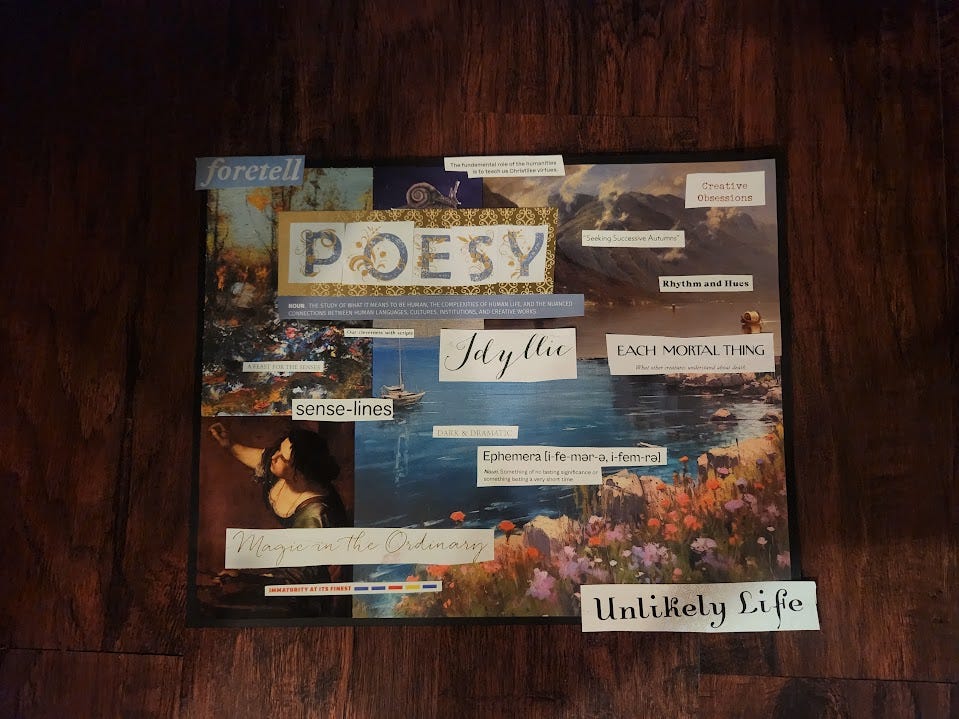
That question—how to live poetically in a world that rewards efficiency—has quietly reshaped how I write, teach, and think. Since then, I’ve begun to understand a little more of what it might mean to live poetically. Living poetically, I’m learning, has less to do with writing poems or curating an aesthetic life and more to do with adopting a poetic disposition toward the world: paying attention like a poet, noticing what others might overlook, letting awe interrupt the constant call of efficiency, sitting with questions without wringing fraught answers out of them.
I’m realizing, too, that this longing to live poetically has sharpened in response to academic life. I spend 50+ hours a week in academic spaces, where productivity culture increasingly shapes the expectations of scholarship. The focus on quantifiable outcomes—“publish or perish”—too often yields research we don’t need and flattens the wonder that drew many of us here in the first place. This is not the version of academic life I want to inhabit. I want the process of my scholarship to be the point. I want it to change me in meaningful and life‑giving ways.
For the past few years, I’ve been immersed in literature on slow living philosophy—an obsession that began with Jenny Odell’s How to Do Nothing. Slow philosophy stands in sharp contrast to the productivity culture of neoliberal university life, and I loved Odell’s ideas so much that I decided to research them for my dissertation. One of my earliest challenges was defining what “slow philosophy” actually meant in practice.
During that wrestle, I kept thinking about the crows Odell befriends from her San Francisco balcony because I have a similar relationship with another corvid, the Stellar’s jay. A nesting pair lives in the blue spruce across the street from my front door, and if I don’t toss peanuts onto my porch early enough in the day, they perch on my cherry tree and squawk insistently at the door until I do. We’ve been together for four years.
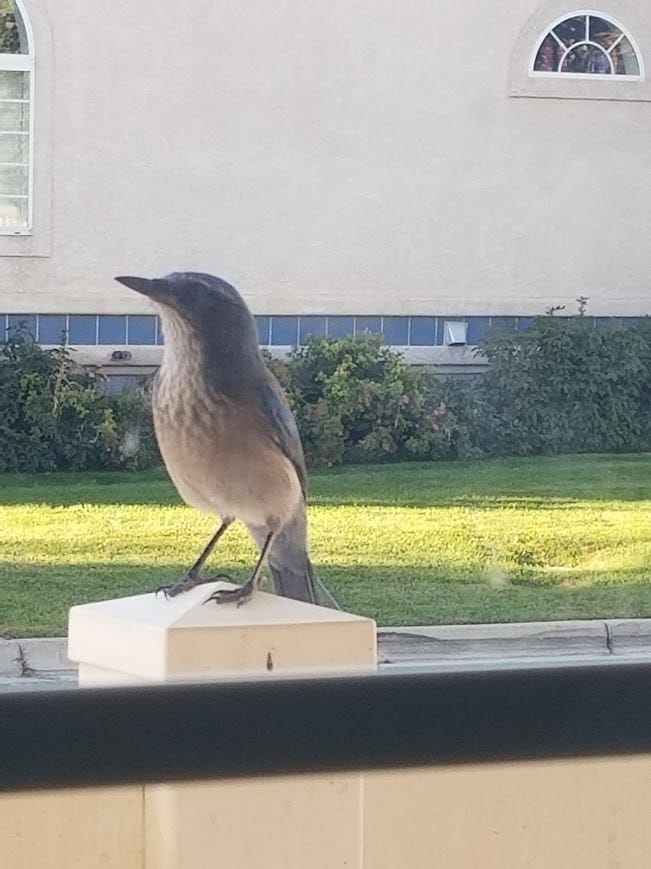
Corvids are often considered among the world’s most intelligent birds, and I found myself wondering what they might teach me about slowness, attention, and joy. From this line of thinking, my scholarly framework for slow philosophy emerged. I call it the Magpie framework: Meditative, Attentive, Grounded in body and place, Paced naturally, Intentional, and Environmentally supported and supportive.
Over time, that framework moved beyond my dissertation and into my daily life—into how I collect ideas, design learning experiences, and share unfinished thinking. This broader posture is what I now call the Magpie Practice.

Magpies arrived in my scholarship not as a mascot, but as a teacher. They are notorious collectors. Drawn to what glints, gathering without needing immediate use or justification. Their delight in collecting for the sheer joy of it, and their refusal to live by utilitarian rules, resonated deeply with my desire to live poetically.
The Magpie Practice grows out of that posture. It is my effort to protect a way of being that begins with attention rather than output, with gathering rather than conclusion.
Practically speaking, the Magpie Practice is a series of essays, video essays, and podcasts that invite you to witness—and join, if it resonates—my ongoing attempt to live poetically. It is a practice of attention, collection, and trust. I’m interested in making room for wonder and letting meaning arrive in its own time.
The Magpie Practice asks:
What keeps glinting?
What do I notice about the things I’m collecting?
What might happen if I let them rest a little longer?
In this space, I’ll show my wandering and wondering, my curiosity and collections, my questions and my uncertainty. Too often, these modes of thinking and being remain hidden, especially from learners, who then feel frustrated by their own nonlinear, unfinished processes. The Magpie Practice is my attempt to make those invisible processes visible—not as a model to replicate, but as an invitation to linger, collect, and trust your own unfolding ways of thinking.